
Why Como? A Club the English-Speaking World Is Only Beginning to Discover
For years, Como 1907 existed beyond the edge of English-language football coverage. Now the club is climbing the ladder, and there is far more to its story than a beautiful view.
 Sofia
Sofia
There is a problem with writing about Como: sooner or later, you have to mention the lake.
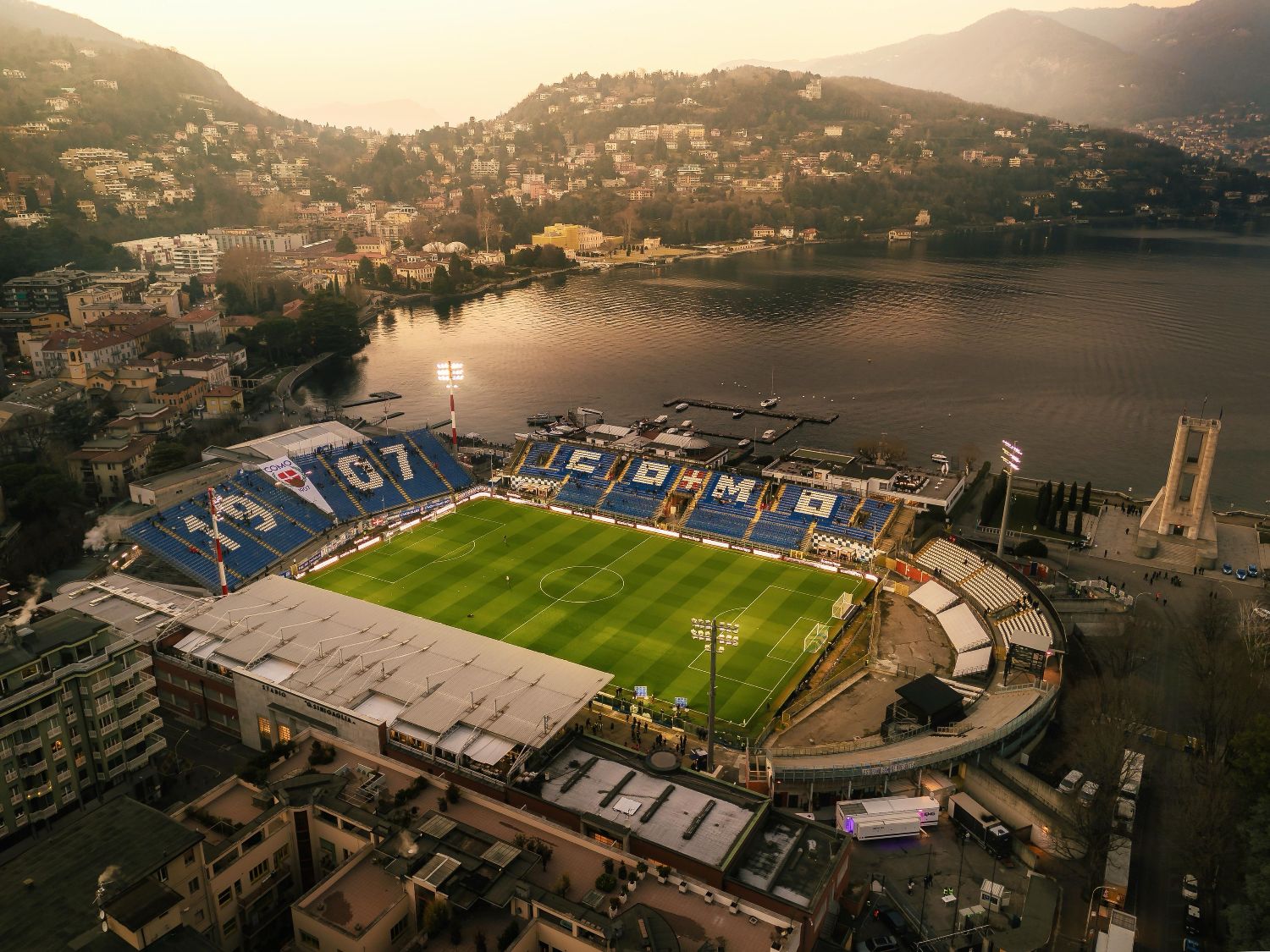
It is right there behind the stadium, appearing over the shoulder of every television presenter and in the opening paragraph of almost every visiting journalist’s report. The Stadio Giuseppe Sinigaglia sits in a setting so improbable that, to anyone discovering Como for the first time, the football can feel like part of the scenery.
The photographs practically caption themselves. The most beautiful away day in Italy. Football by the water. A stadium fit for a postcard.
All of that is true. It is also nowhere near enough.
Como 1907 is not interesting simply because of where it plays. This is a club founded more than a century ago, shaped by its city and carried through long periods when very few people outside Lombardy were paying attention. It has known Serie A, the lower divisions, financial collapse, rebirth and the peculiar stubbornness required to keep going when the wider football world has moved on without you.
Now that the wider world is looking again, it is worth asking a simple question: why Como?
A football club, not a backdrop
For many English-speaking supporters, Como entered the picture suddenly. The club returned to Serie A in 2024 after a 21-year absence, bringing with it ambitious ownership, famous footballing names and an image that travelled very easily across social media.
From the outside, it could look like a new story: an attractive club in an attractive place, arriving in the top flight at precisely the moment football became obsessed with destinations, aesthetics and “projects.”
But Como did not begin when the cameras came back.
The club was founded in 1907. Generations of supporters followed it long before a lakeside stadium became valuable online real estate. The Sinigaglia is picturesque, certainly, but it is also a real football ground with memories embedded in it: promotions celebrated, relegations endured, ordinary league matches made significant because someone attended them with a parent, a grandparent or a child.
That distinction matters. A place can be beautiful without being superficial. In Como, the lake and the football do not compete for authenticity. They belong to the same city.
The years outside the frame
English-language coverage of Italian football naturally concentrates on the largest clubs. Juventus, Milan, Inter, Roma and Napoli generate enough news to fill an entire publication before anyone reaches the rest of the table. Clubs outside that circle tend to appear only when they are promoted, cause an upset or sign someone recognisable.
For Como, the long absence from Serie A created an even larger blind spot. While the club moved through the lower reaches of the Italian game, international coverage became little more than an occasional line in a results service. There were seasons, crises, recoveries and people doing the unglamorous work of keeping a club alive, but very little of it crossed the language barrier.
That is one reason the present can be misunderstood. Como’s rise may feel fast to a new overseas audience, but supporters do not experience a club only through its upward curve. They remember what came before it. The excitement of the return makes sense precisely because of the distance travelled.
The 2024 promotion was not merely a useful entry point for a new ownership era. It ended a wait that had lasted 21 years. For older supporters, it restored a piece of the club’s identity. For younger ones, it turned inherited stories into something they could finally experience for themselves.
A club attracting a new kind of attention
There is no point pretending that Como’s circumstances have not changed dramatically. The modern club is ambitious, internationally visible and capable of attracting players, coaches and commercial interest that would once have seemed far beyond its reach.
That creates a tension worth following.
How does a club grow without becoming detached from the people who sustained it when growth seemed impossible? How does it welcome new supporters without reducing itself to a fashionable weekend? How does it build something modern in a city where history is never very far away?
Those are not questions with tidy answers, and they should not be treated as accusations disguised as questions. Ambition is not a betrayal. Investment is not automatically an erasure of identity. But change this rapid deserves close attention—not only to transfers and results, but to what the club becomes along the way.
That is part of what makes Como compelling now. There is the football itself, of course: the tactics, the recruitment, the players developing in public and the weekly problem of surviving and succeeding in one of Europe’s most demanding leagues. Around it sits a bigger story about belonging, memory and who gets to claim a club when its audience suddenly expands.
Why it matters from far away
I grew up in Brooklyn with Como as part football club, part family inheritance.
My father was born in Bergamo and chose Como in the 1980s, partly out of contrariness and partly because football loyalties are rarely as rational as people pretend. That decision travelled with him. It became scores checked from another time zone, names pronounced properly when English commentators could not, and the familiar emotional arithmetic of supporting a club that offered very little convenience in return.
There are many versions of that story. Italian clubs have followers scattered across countries and generations: people raised on family allegiances, people trying to recover a connection that migration weakened, and people with no Italian background at all who simply found a team that meant something to them.
For those supporters, language matters. You can follow a result without understanding a club. You can see a goal, read a transfer rumour or check the table in English while still missing the conversations that give those things their proper weight.
Como deserves more than occasional curiosity. It deserves coverage that remembers what happened last month, not just what happened in the latest match; coverage willing to look at the numbers without mistaking them for the whole game; coverage that can enjoy the romance of the setting while remaining serious about the football played inside it.
So, why Como?
Because few clubs contain such an unusual mixture of old identity and new possibility.
Because the years away matter as much as the return.
Because the Sinigaglia is more than a photograph, and the people in its stands are more than atmosphere for somebody’s travel story.
Because a club can be local without being inaccessible, and international without becoming like every other club.
And because, after years at the margins of English-language football coverage, Como is no longer a story that can be told properly in a paragraph at the bottom of a Serie A round-up.
That is why Marco and I built ForzaComo. We will cover the matches, players and numbers, but also the history, culture and arguments surrounding them. We will write for lifelong supporters, the diaspora, new fans and curious neutrals—anyone who wants to look past the postcard and stay for the football.
The lake will still make its way into the photographs. It would be foolish to complain.
But the club belongs in the foreground.
Comments (0)
Be the first to comment.