
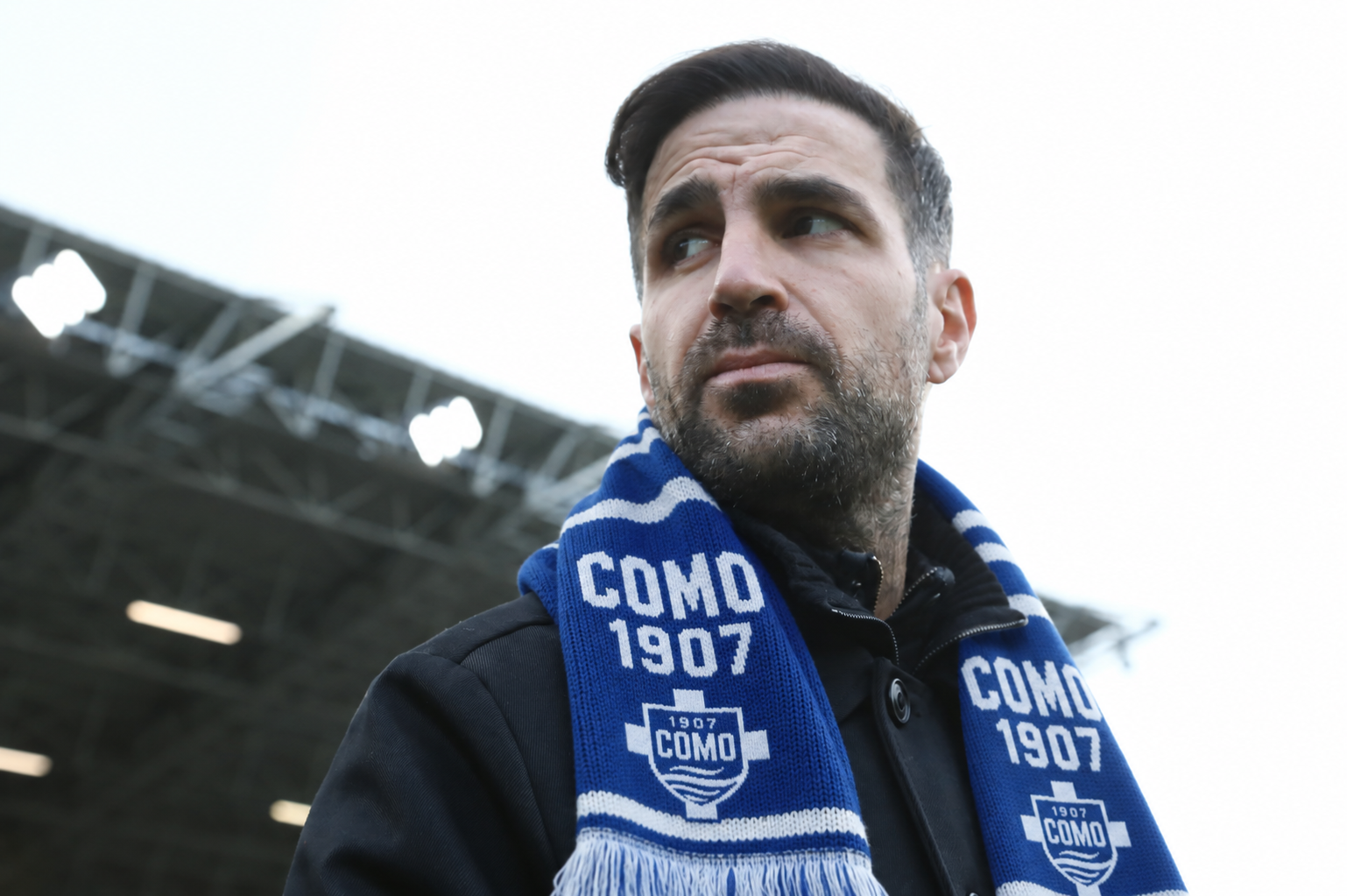
What Happens if Fabregas Leaves Como?
Cesc Fàbregas has helped Como imagine a different future. Could that future survive his departure? His latest comments give supporters reasons to relax, while the football and finances make a strong case for planning ahead.
 Marco
Marco
There is a peculiar tax on supporting a club that starts doing something interesting. Eventually, every conversation about how well things are going becomes a conversation about who might leave.
For Como, that conversation keeps finding its way back to Cesc Fàbregas. We can be discussing a midfield rotation or a young player’s improvement and, within minutes, someone has opened the door marked Barcelona.
It is understandable. Cesc has become central to how this team plays and how we think about its possibilities. Losing him would hurt. But the question deserves more than either a promise that he will stay forever or a prediction that everything falls apart when he goes.
My reading, as of 6 October 2026, is that there are good reasons to expect him to continue at Como for now. A future departure remains entirely plausible. If it happens, the club has a credible route forward—provided it prepares for the football consequences as carefully as the contractual ones.
Will Fàbregas leave Como?
The strongest recent evidence comes from Fàbregas himself.
At the Festival dello Sport in Trento on 4 October, he explained that Como’s shared vision and mutual trust were reasons he preferred to keep developing there. He also spoke about the responsibility he feels towards players who chose the club because they believed in him, including Nico Paz, Álex Valle, Máximo Perrone and Lucas Da Cunha. Sky Sport’s report and video provide considerably more substance than a recycled list of interested clubs.
Those comments are encouraging because they identify things Como can actually offer: influence, trust, continuity and the satisfaction of seeing a plan work. None is an unbreakable guarantee. All are reasons why the next glamorous vacancy need not automatically become his next job.
His contract runs until June 2028. Como’s original announcement confirmed a four-year appointment in 2024. The recent complication is the reporting about special exit provisions involving Arsenal, Chelsea and Barcelona.
In a 24 September interview with Betarades, Gianluca Di Marzio described clauses concerning those clubs and a coach prepared to wait for the right opportunity. GOAL subsequently reported favourable financial terms.
The exact contractual wording and fee have not been publicly established in the material available for this article. We should therefore describe a reported exit mechanism, without pretending to know its complete operation. The reporting is not evidence of an accepted offer or an agreed departure date.
My answer to “will Fàbregas leave?” is therefore: possibly one day; there is no persuasive public evidence here that he is preparing to leave now. His latest explanation of why he wants to remain deserves real weight.
We can enjoy having an ambitious manager. Como benefits from that ambition every week.
What Como would actually need to replace
A formation would be the easy part.
The Coaches’ Voice analysis of his Como team, published in October 2025, describes a broadly 4-2-3-1 starting structure, midfielders moving into different positions during build-up, full-backs advancing and attackers receiving inside. Without the ball, the team has often formed a 4-4-2, using coordinated pressure to force opponents towards the touchline.
That is a useful account of the foundations, rather than a claim that every match in 2026 follows an identical diagram. The essential relationship is between possession and penetration: move opponents, create a passing lane, then use it. The associated risk is the space left behind when several players advance or rotate simultaneously.
A successor would inherit players familiar with those decisions. My preference would be to preserve that knowledge and simplify selectively where necessary.
For example, a coach could initially keep one full-back deeper when the other attacks, giving the centre-backs more protection against a turnover. A midfielder could stay within passing distance behind the ball instead of joining every attack. The front line could press aggressively on agreed triggers—a backwards pass or a poor first touch—while accepting a compact middle block when the first opportunity disappears.
These are proposed adjustments, not claims about instructions Como currently use. Their purpose would be to make the transition manageable without asking a technically strong squad to abandon the football it has learned.
Paz would still need access to useful space between the lines. Perrone would still need passing options when receiving under pressure. Wide players would need clear agreements about who holds the touchline and who moves inside.
The new coach should be able to explain all of that before discussing summer signings.
Three directions after Cesc
The first, and my preferred option, is continuity with room to improve: appoint a coach who values progressive possession, coordinated pressing and player development, but brings independent solutions to the team’s weaknesses.
That would preserve much of the squad’s usefulness and reduce the amount of tactical relearning. The danger is mistaking similar vocabulary for similar competence. Plenty of coaches say they want brave football. Como would need evidence of how a candidate teaches it, adapts it and supports players when it fails.
Alberto Aquilani is a name with a genuine reporting trail. Di Marzio identified the Sassuolo coach as someone whose style could interest Como if Fàbregas departed. Gazzetta di Modena also reported the connection on 26 September, alongside Aquilani’s indication that he was happy at Sassuolo. That makes him a relevant name to discuss, not a confirmed successor or an available appointment.
The second direction is a more controlled version of Como. The club could choose a coach who keeps the ball-playing foundations while placing greater emphasis on defensive spacing, selective pressure and managing different phases of a match.
This has appeal if the next stage demands greater consistency across domestic and European football. It could help Como protect leads and expend energy more selectively. The trade-off would need watching: becoming harder to counterattack is useful; leaving creative players isolated from one another would be expensive in every sense.
The third is an internal transition, at least temporarily. Retaining coaches who know the players and training routines could reduce disruption after a sudden departure. But familiarity alone cannot establish that someone is ready to lead a Serie A and European campaign. Any internal candidate should face the same assessment of tactical judgment, communication and authority as an external one.
A planned summer succession would allow more choice, training time and recruitment coordination. A midseason departure would make continuity more valuable immediately. Como should prepare for both possibilities rather than treating succession as a single shopping list.
The mental challenge: keeping belief in the building
For players, a managerial change can unsettle the basic assumptions behind their career decisions. Who believes in me now? Does my role still exist? Will the next coach tolerate the mistake the previous one asked me to risk?
We cannot know how individual Como players would react. But those are reasonable transition risks for a squad shaped so visibly by one coach.
The answer should begin with individual conversations and clear roles. Senior players would need to help establish the new coach’s authority. Younger players would need development plans that survive the change of manager. Recruitment staff would need to explain why a player fits Como beyond his relationship with Cesc.
Supporters have a role too. An August discussion on the Como supporters’ subreddit showed how strongly some fans already associate him with the club’s modern identity, with contributors readily describing him as a legend. It was a small, self-selecting discussion, not a survey of the Sinigaglia, but the affection is recognisable.
The independent fan site Sempre Como offered another useful perspective on 2 October: acknowledge the attraction of Barcelona while hoping Como has become important enough to make him hesitate. That is one supporter outlet’s view, rather than a universal verdict.
For me, the emotional task would be to appreciate Cesc without making his successor compete against a memory from the first training session. A new manager should be judged on whether the team is learning, competing and developing—not on how closely he resembles the man beside whom we first imagined this future.
There would be difficult afternoons. They would not automatically mean the project was over.
The finances: continuity has a price, and so does upheaval
Como’s backing gives the club options. Its accounts also explain why a managerial change should be handled carefully.
Calcio e Finanza’s analysis of the accounts to 30 June 2025 reported approximately €55.4 million in revenue, €158.6 million in costs and a €105 million loss for the football company. It also recorded substantial shareholder contributions. These are historical figures for 2024/25, not a current-season forecast.
The wider group is a different accounting perimeter. Gazzetta’s reporting on the pro-forma consolidated statements put the 2024/25 group loss at roughly €132 million, including associated activities. The two losses must not be added together. Nor should either be treated as the amount Como would suddenly need to find because a coach left.
The financial exposure of a succession would have several parts.
There would be the direct cost of recruiting a manager and staff, including compensation where applicable. Any payment received for Fàbregas would depend on the actual agreement; there is no sound basis here for budgeting a particular windfall.
More consequential could be the cost of changing the squad. If a successor required several different player profiles, Como might have to buy replacements while still paying wages and recognising the accounting cost of earlier purchases. An expensive player becoming less useful does not make his contractual costs disappear.
Performance would matter as well. A difficult transition could affect future European qualification, prize income and bargaining strength in player sales. Conversely, a well-chosen successor could preserve development and results without requiring a rebuild. These are financial scenarios, not forecasts of a specific loss or gain.
European regulation strengthens the argument for discipline. UEFA’s 2026 rules set a 70% squad-cost limit, with a defined calculation covering relevant employment costs, registration amortisation and other items. Owner wealth alone does not establish compliance. Equally, dividing selected figures from old accounts would not establish a current breach.
The practical point is straightforward: protecting the usefulness and development of the existing squad is financially valuable. Tactical compatibility belongs in the budget discussion.
Como already has reasons to think beyond one manager
The club’s leadership has publicly acknowledged succession.
In a March interview with Rivista Undici, president Mirwan Suwarso said a future departure was something Como had to anticipate and envisaged Fàbregas choosing his replacement. He also described collective football decisions through a six-person board, while recognising Cesc’s considerable influence.
That is evidence of an intention to plan. It is not proof that a completed succession process already exists. My preference would be for Cesc to contribute his knowledge while the club retained responsibility for testing candidates, agreeing the budget and making the appointment.
His shareholding adds another dimension, but does not guarantee that he stays as coach. In April’s City AM interview, Suwarso explicitly allowed for a departure and said structures existed for Fàbregas to retain shares if he did not join an Italian competitor. Coaching and ownership therefore should not be treated as inseparable.
For supporters, the encouraging possibility is that an eventual departure could be cooperative. Advance notice, a proper handover and continued respect would give Como a much better chance than a hurried separation followed by an improvised search.
Meanwhile, the club should make its scouting knowledge, training principles and player development work durable. Every season Cesc stays is an opportunity to strengthen those foundations.
Why I am optimistic
I want Fàbregas to stay. The latest evidence gives me reason to believe he wants to keep working here too.
He has already explained the value he places on the relationships and freedom he has at Como. From a fan’s perspective, that matters. We are allowed to think this job has attractions of its own, even when another club has a larger trophy cabinet.
If he eventually decides to leave, Como will face a demanding appointment and an emotional adjustment. The sensible direction would be to preserve the squad’s technical strengths, support the players through the change and resist an unnecessary overhaul.
There is a future in which Cesc stays long enough to take this much further. There is also a future in which the work he leaves behind helps another coach succeed.
For now, I would rather look forward to the next Como match than spend the season rehearsing a goodbye. We can prepare for change and still expect good things from what we have.
Comments (8)
Personally I’m a new fan (this season) so I’m currently not as attached to Cesc and the players as you all are, but it’s clear to see Cesc is integral to everything that is going well right now within the club. I do think Mirwan now knows the importance of having the right man at the helm though and if Cesc does eventually leave I’m confident they would make big moves to get the successor in.
Mirwan was actually who sold me on the club initially, I was watching all his interviews before the season started and his vision and how he speaks about the club was incredibly exciting and fresh.
In regard to Baturina… that young man is an absolute baller! How can anyone not be thrilled with everything he does???