
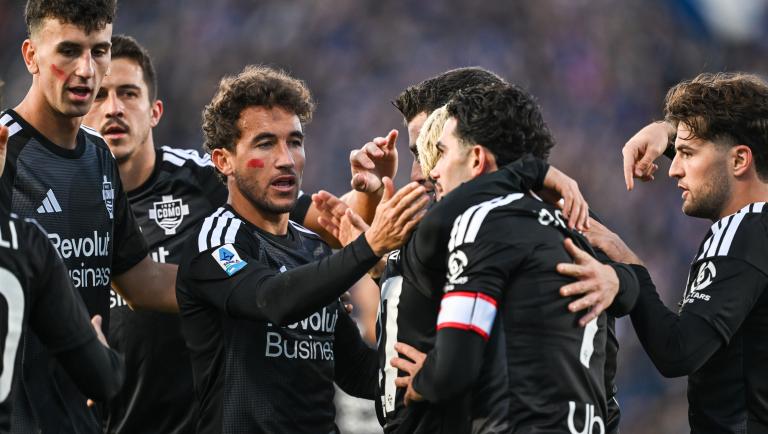
Como 2–0 Cagliari: Couto Delivers, Ramón Does the Rest
Jacobo Ramón and Lucas Da Cunha headed Como back to winning ways, both from Yan Couto crosses. Cagliari made the first half uncomfortable, but a more controlled second period delivered three points with Nico Paz and Máximo Perrone starting on the bench.
 Marco
Como’s response to the defeat at Inter was a victory that required several different strengths: accurate delivery, decisive defending and, eventually, the ability to make a two-goal lead feel secure. Cagliari had enough opportunities to complicate the afternoon, particularly before half-time. The fact that they left with nothing owed a great deal to Jacobo Ramón, whose intervention in front of his own goal was as valuable as the header he scored at the other end.
The 2–0 win came through Ramón after 24 minutes and Lucas Da Cunha after 56, with Yan Couto supplying both. It took Como to 26 points and provided a welcome restart after the international break. More encouraging still, both goals arrived before Nico Paz and Máximo Perrone entered the match. Fàbregas was able to reduce their workload without spending the afternoon waiting for them to rescue the result.
Cagliari made the first half difficult
There were understandable reasons for the changes. Paz and Perrone had returned late from Argentina duty, while Kaiki started at left-back and Samuele Ricci partnered Luis Milla in midfield. Mattia Liberali also received a start. With AEK Athens visiting on Tuesday, this was a selection that had to account for more than one match.
The early football was less reassuring than the final score. Kaiki sent Como’s first notable opportunity over the bar, but Daniel Maldini soon began finding space to carry Cagliari forward. His ability to advance into dangerous areas gave the visitors a route through our possession, and taking the lead did not immediately close it down.
Cagliari’s own report records the most threatening sequence: Maldini’s work created a close-range opportunity for Paul Mendy after 35 minutes, only for Ramón to intervene and the ball to go narrowly wide. Maldini then threatened again after combining with Jacopo Fazzini, without finding the target.
Those moments matter when judging the performance. A clean sheet can conceal how close a match came to changing direction. Como needed a crucial recovery intervention and benefited from Cagliari’s failure to finish; the opening half was not a demonstration of complete defensive control.
Fàbregas acknowledged that in his post-match press conference, identifying several dangerous counterattacks and crediting Cagliari’s attacking approach. His assessment was more useful than an attempt to describe the afternoon as perfect. Como improved during the game, and that improvement was necessary.
Two crosses, two headers and a plan that worked
The most important tactical detail was supplied by Fàbregas afterwards. Speaking to DAZN, he explained that Como had worked specifically on crosses in preparation, having identified that route as a way to hurt an opponent that restricted space between the lines.
That context makes the two goals particularly satisfying. Como were prepared to attack the area from outside when central combinations were difficult. Couto provided the quality, but the movement to meet his deliveries was just as important: Ramón arrived for the opener, and Da Cunha supplied the decisive run for the second.
My reading is that the variety of the targets made this approach harder to defend. Cagliari could not concentrate solely on Douvikas and assume the aerial threat had been accounted for. A centre-back joining the attack and a midfielder arriving into the area asked different marking questions, with both rewarded by precise service.
There is a tendency to treat crosses as evidence that a possession team has run out of ideas. Here they were an idea developed for a particular opponent. Fàbregas deserves credit for recognising the opportunity, and the players deserve credit for executing it twice.
Couto makes the right side decisive
Couto’s two assists were an excellent contribution from an area of the team that has attracted understandable scrutiny. With Diao absent, Como need the right side to provide attacking width without leaving the rest of the team exposed. Against Cagliari, its attacking value was unmistakable.
The Brazilian’s delivery gave two teammates the chance to finish without needing an additional touch. That speed matters: a defence can recover while an attacker controls a difficult ball, whereas a well-placed cross allows the finish to follow immediately. Da Cunha’s header for the second was especially emphatic.
Tattico’s updated Como statistics now list Couto as the club’s leading Serie A assist provider with four. For all the discussion about how to balance his role, this is a substantial reason to retain his attacking freedom.
One productive afternoon does not settle every question about the flank. The first-half counterattacks remain part of the evidence. But this match showed exactly what Como stand to gain when Couto has space and the runners in the box match the quality of his delivery.
Ramón was the decisive player
Couto has a strong claim to the individual honours, but Ramón is my man of the match. His opening goal gave Como an advantage during an uncertain period, and his intervention against Mendy helped preserve it. Remove either contribution and the second half becomes a different assignment.
Ramón also offered a sensible perspective afterwards. In comments reported by Prima Como, he explained that joining the attack was something he had enjoyed since his youth career, while making clear that defending remained his priority. That distinction suited this performance: his attacking contribution was valuable because he also delivered when Como needed him closest to their own goal.
Fàbregas was pleased with the defender’s development in front of goal, but also returned to the standard set by Inter’s forwards. It was a useful reminder. Being outstanding against Cagliari does not erase the difficulty of dealing with Thuram and Esposito; it does show a young player responding well after a demanding match and an international camp in which he did not play.
Da Cunha scores on an afternoon he was meant to rest
Da Cunha’s goal carried an additional significance once Fàbregas explained his original selection plan. The coach had intended to rest him and use Maxence Caqueret, but a minor problem detected after Caqueret felt discomfort on Friday forced a change. The captain was needed again after his international workload with France.
Fàbregas did not pretend Da Cunha had been excellent throughout. He was critical of the first half while praising the solutions the midfielder provided later. That is a fair description of an afternoon in which the most important contribution came through an intelligently timed arrival and a decisive finish.
The situation also puts the rotation into perspective. There are still players available to change a match, but the options are unevenly distributed. Resting one midfielder becomes harder when another is unavailable, and injuries in the attacking positions limit what can be done from the bench. Da Cunha’s adaptability remains enormously useful; relying on it should not obscure how much he is being asked to carry.
A two-goal lead before the Argentine reinforcements
Da Cunha scored immediately before Paz and Perrone replaced Liberali and Milla in the 57th minute. That sequence is worth emphasising. The starting side had already produced the decisive advantage; the substitutes then helped Como play from a position of strength.
ANSA’s match report describes a second half in which Como established themselves further forward and made Cagliari’s attempts to recover increasingly difficult. The visitors had shown intent immediately after the interval, but the second goal changed what they could realistically ask of the game.
Lahdo and Smolčić subsequently replaced Ricci and Da Cunha, with Valle arriving late for Baturina. Fàbregas’s praise for Lahdo was encouraging, particularly given the shortage of alternatives. The finish also brought a reminder of Paz’s capacity to create a chance: Douvikas went close to a third after being supplied by him, with Caprile diverting the shot onto the woodwork.
Como did not need that third goal. The important development was that the closing stages no longer resembled the first half, when a single Cagliari attack could expose us. The team had turned a vulnerable lead into a manageable one.
A useful win before Europe returns
There is plenty to like about this result without asking it to prove too much. Como won after the international break, found a successful attacking route without starting Paz, and gave meaningful minutes to players outside the most familiar lineup. Ramón defended a lead he had helped create, Couto supplied both goals, and Da Cunha delivered when the intended rest was no longer possible.
The work still to do is visible in those first-half transitions. Better finishing from Cagliari could have changed the afternoon, and Como cannot assume there will always be a recovery challenge available to correct the initial problem. Equally, adapting during a match is a strength, and the control after the second goal was a marked improvement.
AEK Athens come to the Sinigaglia on Tuesday, 24 November, with kick-off at 21:00 CET. Como approach that Champions League fixture with another league win secured and two important returning internationals spared a full ninety minutes. After San Siro, that is a convincing way to resume the season.
Marco’s man of the match: Jacobo Ramón. The opening goal and the intervention against Mendy were the two contributions that shaped the contest before Como established control.
Comments (6)